Built fast and right, from the first version.
Cisely is the agentic product development platform for high-agency system thinkers — people out to challenge the status quo and build high-value solutions that last.
It is designed from the ground up to give you 100x leverage on your single greatest competitive advantage: your vision. It does so with a fully integrated context engineering stack that lets you harness AI as a force multiplier. You gain the operating velocity of an AI-native startup while keeping the operational control of a Fortune 500 enterprise, right from day one.
You no longer have to choose between fast and right. You can have both.
- Concise
- The business context — demand, and how you respond
- Precise
- The engineering context, derived from it
- Answerable
- Every story links to the expectation it serves
right nowsomebody is asking for something ordinary
Any AI coding agent will build one of these by this afternoon. None of these sentences carries what the thing will actually be judged on.See what one button costs
Two graphs, one model
Your business is a graph. So is your software. They are the same graph.
A belief written twice in two documents can drift and nobody finds out. A belief that is a node can be pointed at — by a goal on one side and a strategy on the other — and whether they converge is a fact you can query. That is the whole reason this is a graph and not a folder of pages.
Concise
Business context graph
Who the business serves, what it intends, what it promises, and how it will know the promise was kept — as nodes with real links, not chapters in a document.
Edgesrooted inheld byservesmeasures
Mission
Purpose, just cause, vision and core values. One per workspace, and the thing the whole model hangs from.
Beliefs
The convictions underneath. Each carries a conviction level — assumed, observed or validated — so a shaky assumption is visible instead of inherited.
RefusesA belief is a node in the graph, not a text field, so a goal and a strategy can point at the same one. That coincidence is what alignment means here, and it is measurable.
Agency — demand
Who you serve and what they are trying to get done: personas, operating contexts, stakeholders, goals.
Expectations
The measurable promise a goal implies. This is the hinge — everything downstream has to serve one.
User stories
The only backlog item that must name its reason. Each serves an expectation and climbs a ladder that refuses shortcuts.
RefusesCannot be committed until an expectation it serves is live. Cannot be validated until a metric measures the outcome.
Precise
Engineering context graph
The application that answers it — the plan, the nouns, the operations and the running system, declared as one connected model.
Edgessuppliesdeclaresemitsderives
The overlay
Actors, journeys, business processes, capabilities, systems and screens — the plan, declared in the same model the application is declared in.
RefusesA step that needs a capability nothing supplies yet becomes outstanding work on its own, and clears itself when something supplies it.
The domain
Entities, objects, enums, events, rules, invariants, policies and specs. The nouns of the business and what is always true of them.
The application
Commands, queries, use cases, subscriptions, schedules, routes and gateways — what can be asked of the system, and what happens when it is.
Running, on its own instance
Backend, schema and migrations, API and contracts, typed clients and a web app — published to your project’s own live instance, with an MCP endpoint so agents can use it too.
The two graphs are joined, not exported between. A project reads only what you activated — and from a piece of the engineering graph you can walk back to the expectation it serves, and from an intent forward to everything built for it.
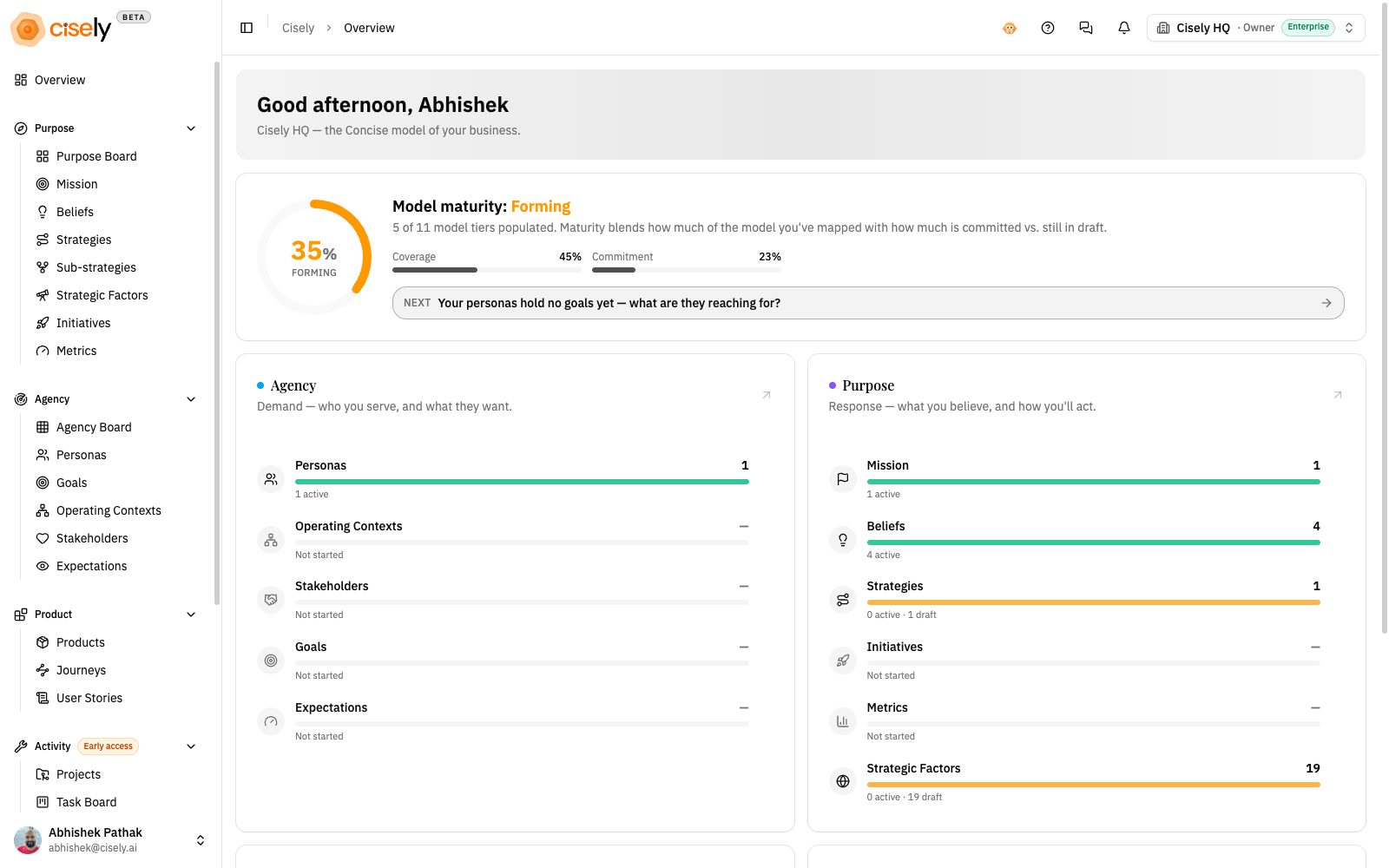
Concise — the business context
You bring the judgement. Paroksh does the drafting.
You do not fill in forms. You tell Paroksh about the business and answer what they ask; they draft the mission, the beliefs, the strategy, the personas. Nothing they write counts until you activate it.
Agency — who you serve
Personas (people, organisations, systems and AI agents), the operating contexts they act in, stakeholders, goals, and the expectations those goals imply.
Purpose — how you respond
Mission, beliefs with their conviction level, strategy structured as Playing to Win, initiatives with a falsifiable hypothesis, and metrics whose observations cannot be edited afterwards.
Draft until you say otherwise
Everything Paroksh drafts arrives as a draft. You read it, change what is wrong, and activate what you agree with — so the model holds what you actually believe, not what was plausible.
Alignment you can see
A belief is a node, so a goal and a strategy can root in the same one. Where they do, the model says aligned; where they do not, it says unbacked — and tells you what to look at next.
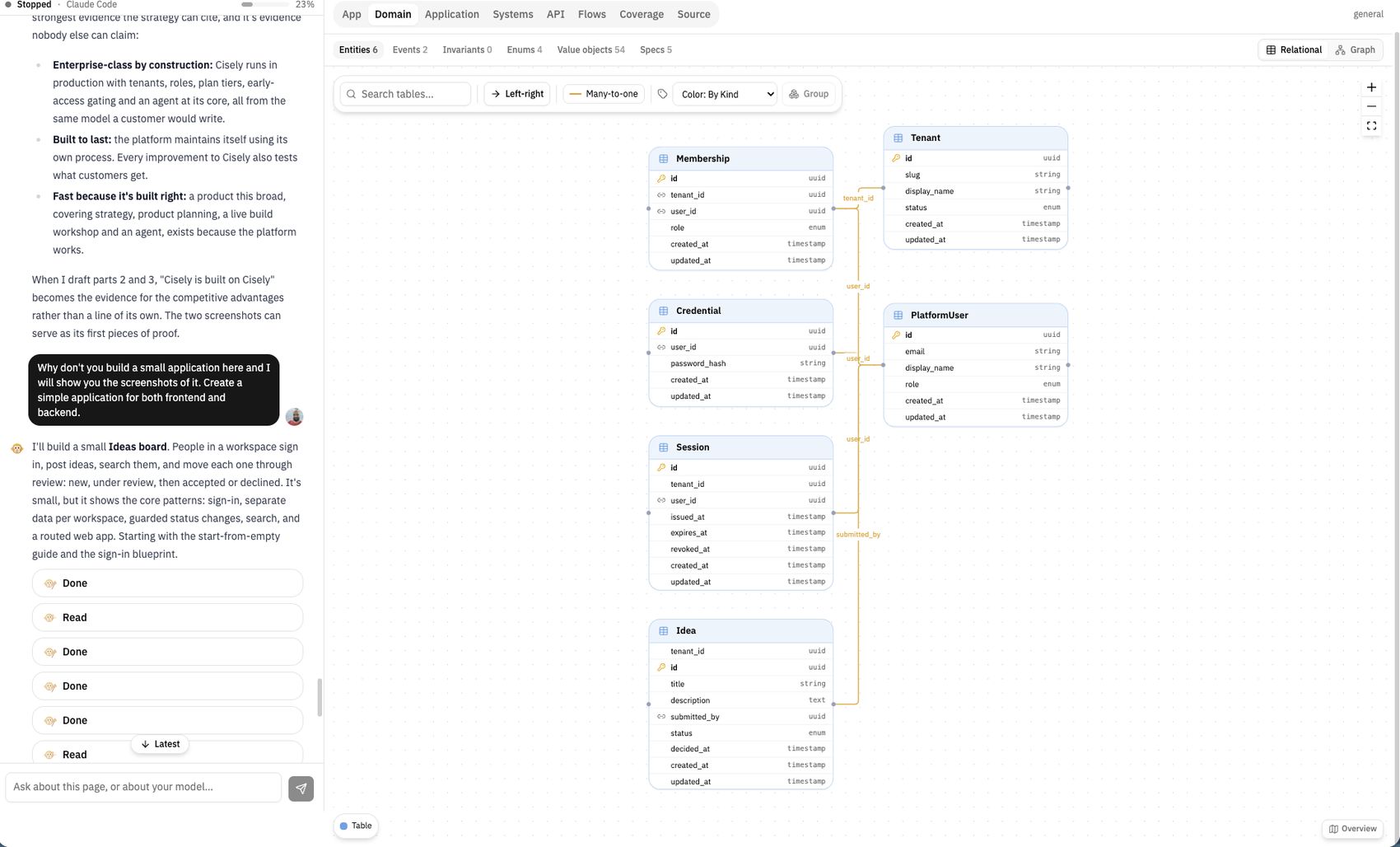
Precise — the engineering context
Paroksh turns business context into engineering context
The same model grows an overlay, a domain and an application — declared in the Vishwakarma modelling language, from which the backend, schema, API, contracts and typed clients are derived.
The overlay carries the plan
Actors, journeys, business processes, capabilities, systems and screens. The architecture is part of the model, so the design cannot drift from what runs.
The domain carries what is always true
Entities, invariants, rules, policies, events and specs — with the reason written beside them, so the next person or agent to open the file inherits the argument, not just the shape.
Review before it ships
Every change on its own branch, with a live preview your team can open. Nothing reaches your live instance because an agent was confident.
Published, and usable by agents
Deployed to your project’s own instance, with an API and an MCP endpoint — so the thing you just built is available to agents under the same rules as everything else.
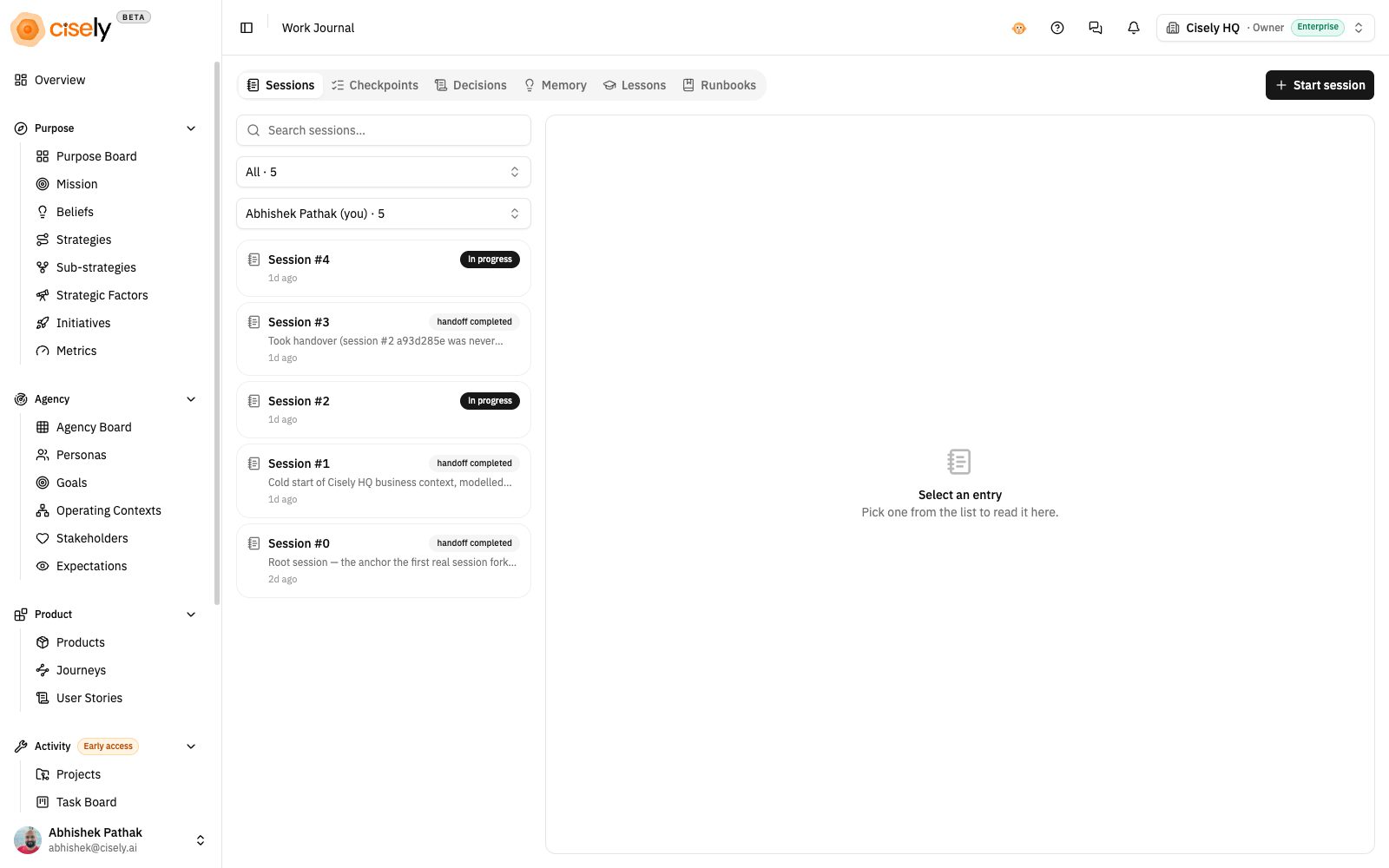
Then a project consumes it
The approved context is what the build answers to
A project reads the context you activated and engineers against it. You are not handing over a prompt; you are handing over what the business has decided is true.
Work traces to intent, both ways
From a piece of the system you can reach the expectation it serves, the decisions taken about it and the conversation around it — and from an intent, everything built for it.
The reasoning survives the session
Decisions carry a status — accepted, rejected, superseded — so a choice that was reversed reads as reversed rather than quietly vanishing.
Review before it ships
Every change on its own branch, with a live preview your team can open. Nothing reaches your instance because an agent was confident.
Judgement comes back to you
When a decision needs a person, the work is handed over finished up to that point — not abandoned, and not guessed at.
What the model looks like
Who may act, and when it refuses, are lines in the file.
This is one command from a model running in production. Everything a reviewer would otherwise have to go looking for — the permission, the condition that refuses the write, the error it answers with — is declared here, in twenty lines, next to the thing it governs. Most days you will not open one of these. But this is the artefact your agent edits, and the backend, the schema and the API are derived from it.
Who may act is part of the operation
The policy travels with the command rather than sitting in a layer a different caller can go around. An agent given this operation inherits its rules — including one granted the operation later.
The refusal is declared, not discovered
The guard names the condition and the typed error it raises, so a client knows the refusal exists before it is written, and the case that should be rejected is as specified as the one that should work.
Every line here becomes an obligation
Each is a falsifiable statement about the running system, so the toolchain can count them and report how many have evidence behind them. This is what makes assurance possible rather than asserted.
command ActivateBelief {
  aggregate  Belief
  operation  update
  visibility public
  doc        "Put a drafted belief into force."
  errors     BeliefNotDraft

  // WHO MAY ACT. Not middleware someone remembered to add —
  // part of the command, and countable.
  policy [
    { leaf {
        name    "steward_only"
        expr    "caller.has_permission('context.belief.write')"
        message "Only a context steward may activate a belief."
    } }
  ]

  // WHEN IT REFUSES, and what it answers when it does.
  guard "status == 'DRAFT'"
        error BELIEF_NOT_DRAFT
        "Only a drafted belief can be activated."

  set status = expr "'ACTIVE'"

  id uuid required
}
The commitment ladder
A story that cannot name its reason does not move.
User stories are the only backlog item that must serve something. Each climbs a ladder that refuses shortcuts — so “why are we building this?” is answerable by construction, and “did it work?” can be asked of everything delivered.
As a persona, when situation, so that outcome.
From the story’s narratorThe only part you writeFrom the expectation it serves
| Move | Refused unless |
|---|---|
| Refine | there is a capability statement |
| Ready | it has a kind, acceptance criteria and a size |
| Commit | at least one expectation it serves is live |
| Deliver | — |
| Validate | a metric measures an expectation it serves, plus a written rationale |
The Overview scores how much of the model is filled in and how much is committed, and names the next best action. Unvalidated work is queryable rather than invisible.
Enterprise-class by construction
The patterns you would otherwise spend two quarters retrofitting.
These are not a hardening phase after the demo works. They are what the model compiles into, from the first version.
Security and tenancy
- Tenant isolation enforced by the database itself, with the tenant taken from the verified caller and never from the request
- Verified sessions, immediate sign-out, and no trust in client-supplied identity
- Authorisation declared per operation — simple roles, relationship-based permissions, or an external engine
- Cross-tenant operations explicit and reviewable; impersonation keeps the original actor for audit
Reliability
- Guarded state changes: the check and the write happen together, and a stale request is refused rather than overwriting a decision
- Events written in the same transaction as the change that caused them
- Reactions that retry with backoff and park persistent failures for review
- Multi-step workflows that commit or fail as one, with typed business errors
Commercial and operable
- Plan tiers, entitlements and pricing models the application enforces
- Per-tenant quotas at the edge, and per-tenant credentials for outside services
- Processes that scale independently — API on request load, workers on queue depth
- Traces, metrics and structured logs at every operation, attributed to the caller
Ready for agents
- Any operation can be offered to an AI agent as a tool
- Human sign-off required by risk level, including two-person approval
- What agents send and receive can be inspected and redacted
- The audit trail records which agent acted, and on whose behalf
Questions
The ones worth asking before you sign up.
Do I have to read generated code to stay in control?
No. You direct and judge; the agent builds. The Workshop gives you eight views of the model — tables, operations, architecture, flows, contracts, coverage and the running app — and Source is there when you want it, not because you need it.
Is this a code generator?
It generates a backend, a schema and its migrations, an API and its contracts, and typed clients — but that is the last stage, not the product. The point is that what it generates is derived from the same model your mission, expectations and strategy live in, so the software cannot drift from what it was for.
What happens when I change my mind?
Change the model and everything derived from it follows. A rename is made once. Schema changes are derived by comparing the model with the database rather than hand-written, and API contracts stay compatible with clients already deployed.
Can I take my application elsewhere?
What Cisely produces is an ordinary production application — a backend, a database, an API, typed clients and a React web app — and the Source tab shows all of it. Hand-written code exists only in declared, countable places.
Who is this for?
People who hold a clear vision and want to direct it themselves, whether that is a founder turning a conviction into a company or an architect inside a large organisation who can see the whole system before it exists. It is not for handing over the vision and hoping.
How finished is it?
We build on Cisely ourselves. The platform reference tracks its own gaps openly: a session cannot yet see a published application’s logs, metrics or incidents, and some modelling mistakes still pass validation silently. We would rather you knew that before you signed up than after.
Get started
Model the business. Then build the thing that keeps its promises.
Start with your mission and let it reach all the way to a running application — or start from a reference implementation and work backwards. Both take an afternoon.
Publishing to your own live instance is available by plan.